
By Gregg Guest, SVP of Product Management at FADEL
Brand protection has entered a new era. For marketing executives, legal teams, and rights managers, brand defense is no longer just about where your content lives, it is about how effectively you govern, track, and enforce it across an increasingly chaotic digital ecosystem.
At DAM NY 2026, I spoke on how artificial intelligence is transforming both sides of brand protection. While bad actors are using AI to scale counterfeiting, copyright infringement, and grey market sales at unprecedented speeds, brand stewards now have AI-driven Rights Management and Digital Brand Compliance technology to fight back.
Here is why the threat landscape has shifted, and how modern Digital Rights Management (DRM) and AI tracking form your true first line of defense.
Brand Protection Under Siege: Millions in Revenue Lost in the Margins
To understand why this matters now, look at the sheer scale of global brand erosion. Global trade in counterfeit and pirated goods is estimated at $467 billion, accounting for 2.3% of all global trade, or roughly equivalent to the entire annual economic output of a developed nation like Austria or Norway.
And that is before we even look at grey market sales. Authentic products moving through unauthorized channels now top $100 billion a year in North America alone.
When an unauthorized reseller lifts your official product images and marketing collateral to look legitimate, the damage goes far beyond a lost sale. It costs a brand its reputation, erodes profit margins, creates customer confusion, triggers channel conflict with authorized partners, and, critically for marketing teams, causes a total loss of control over the brand story.
Proactive protection means monitoring where your products actually appear across third-party marketplaces, storefronts, and social platforms. It means protecting your official assets so bad actors can’t steal them, and enforcing approved channels so revenue stops leaking out the side door.
The AI Reality Shift: Why Bad Actors Are Winning the Speed Race
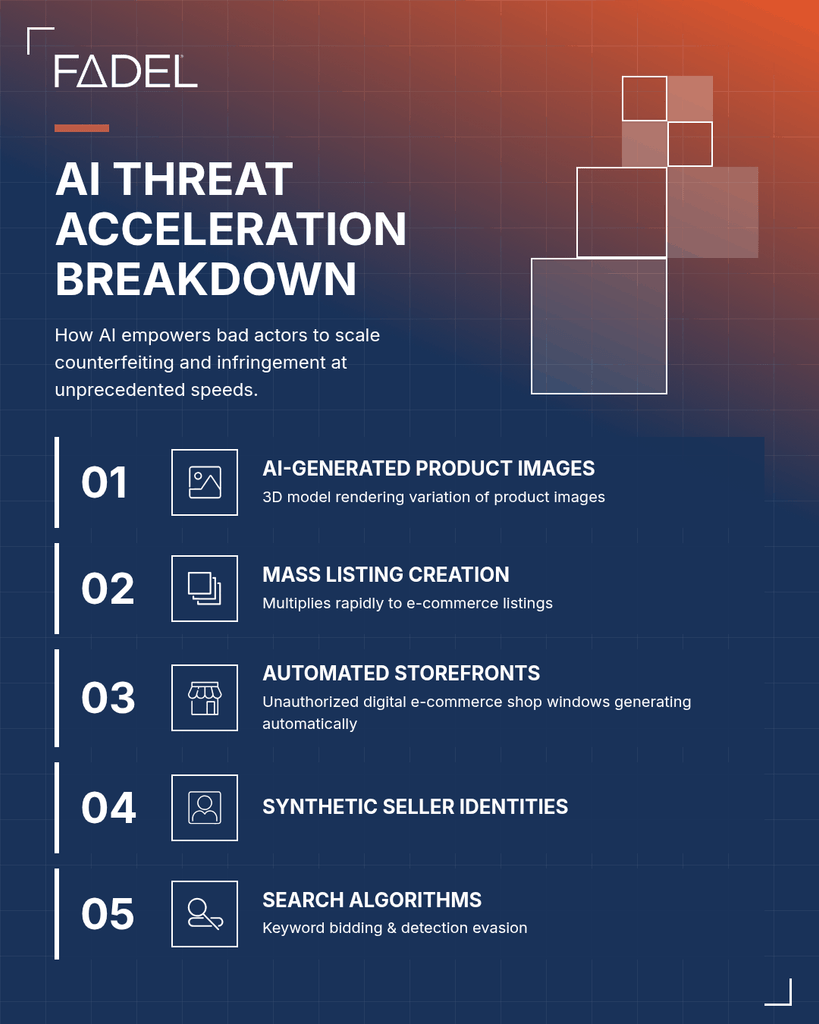
Why has this problem gotten so much sharper in just the last year? AI didn’t just change how legitimate brands work, it changed how bad actors work too, and they adopted it faster.
According to recent data, 85% of brands report AI-accelerated threats, including fake listings, impersonation accounts, and synthetic brand assets.
82% say counterfeiting and impersonation are worse today than they were just two years ago. In Q1 of 2026 alone, AI-driven brand-threat detections grew 16x year-over-year, while fake website detections exploded by 47x.
Here is the part that should worry every marketer: 57% of brands see fake content appear within a week of posting a viral campaign. Nearly a quarter see it within 48 hours.3
AI enables bad actors to generate thousands of unique fraudulent listings in minutes. These assets are deliberately varied so they slip right past traditional detection systems built to catch exact copies, not variations.
Faster. Scalable. Harder to detect. That is the new baseline.
AI Brand Protection: Fighting Speed with Speed
If bad actors are using AI to attack faster, the answer isn’t to rely on manual enforcement; it’s to fight speed with speed.
Old-school enforcement meant manual web searches, reactive takedowns, and treating all listings equally. A hardworking brand protection team might review a few hundred listings a month.
AI-driven enforcement turns that model on its head through pattern recognition across listings, risk-based decisioning, and network-level intelligence. Instead of hundreds, teams can review thousands of listings in the same window.
| DIMENSION | TRADITIONAL ENFORCEMENT | AI-DRIVEN ENFORCEMENT |
|---|---|---|
| Detection | Keyword-based detection | Pattern recognition across listings |
| Review Process | Manual review | Automated risk-based decisioning & prioritization |
| Action | Reactive takedowns | Network-level intelligence & proactive blocking |
| Scale | Hundreds of listings reviewed / month | Thousands of listings reviewed / month |
This isn’t theoretical. Amazon’s own brand-protection program proactively blocked over 99% of suspected infringing listings and removed more than 15 million counterfeit products globally. That is what AI-scale enforcement looks like in practice.
Digital Rights Management: You Can’t Protect What You Can’t See
Here is the core truth of the AI arms race: none of that AI-driven enforcement works if your brand’s rights data and content assets aren’t centralized and governed in the first place.
Whether your marketing assets live in a DAM, cloud storage, or distributed media libraries, an ungoverned repository cannot tell you what is authentic, what is licensed, or what is currently being misused out on the web. AI-driven enforcement engines cannot enforce compliance if they do not know what rights you actually own.
To build an active brand defense engine, you must combine digital rights management with AI-driven content deconstruction. That means analyzing assets at the atomic level:
- Talent & Model Identification: Applying AI facial recognition to identify contracted models, talent, and influencers.
- Logo & Object Detection: Recognizing products, trademarks, and brand logos across static and video assets.
- Gen AI Auditing: Flagging where Generative AI was utilized in asset creation.
- Audio & Music Matching: Auditing licensed voiceovers, sound effects, and background music tracks.
Simply put: you can’t protect what you can’t fully see.
Smarter Counterfeit Detection: Prioritize What Matters Most
Once your content is deconstructed, it needs to be classified, because not every asset carries the same business risk.
The question for brand stewards isn’t “how do we monitor everything equally?” It’s “where do we start, and what actually matters?” By identifying high-risk assets, brands can focus counterfeit detection and enforcement efforts on the products, content, and intellectual property most vulnerable to misuse.
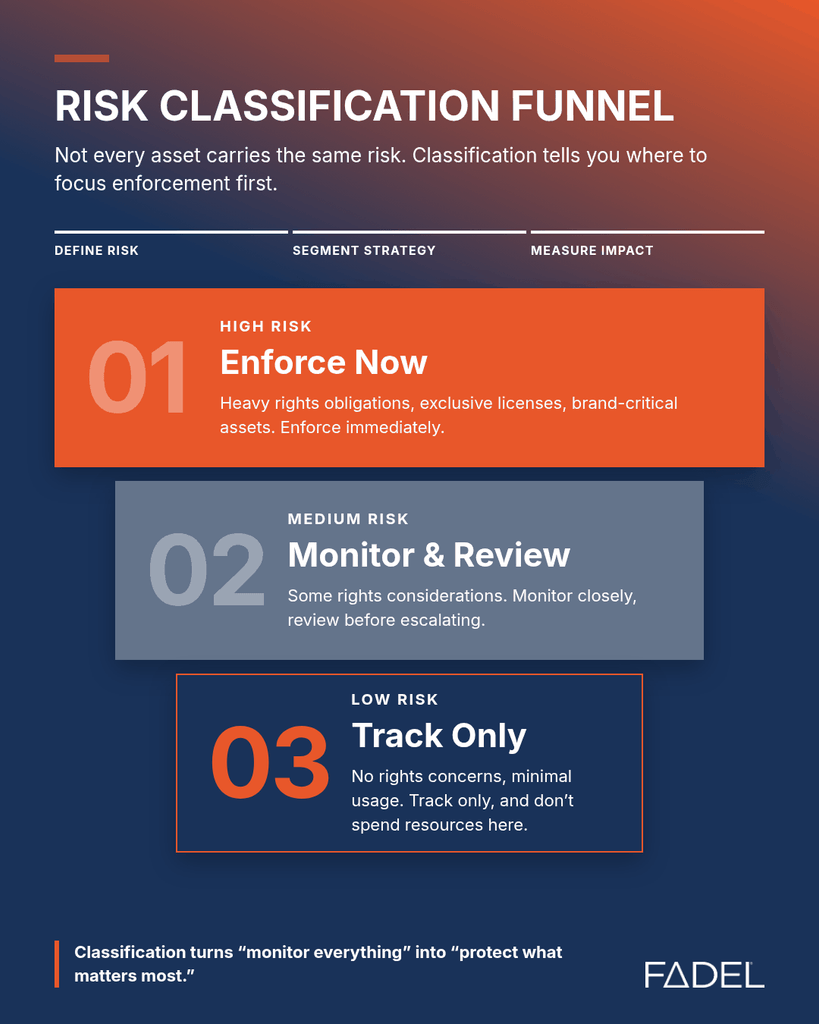
- High Risk (Enforce Immediately): Brand-critical assets, heavy rights obligations, and exclusive talent licenses.
- Medium Risk (Monitor & Review): Assets with standard rights considerations; review before escalating.
- Low Risk (Track Only): No rights concerns and minimal usage; track it, but don’t waste enforcement budget there.
Classification turns “monitor everything” into “protect what matters most.”
Grey Market Monitoring: Why Quarterly Reviews No Longer Cut It
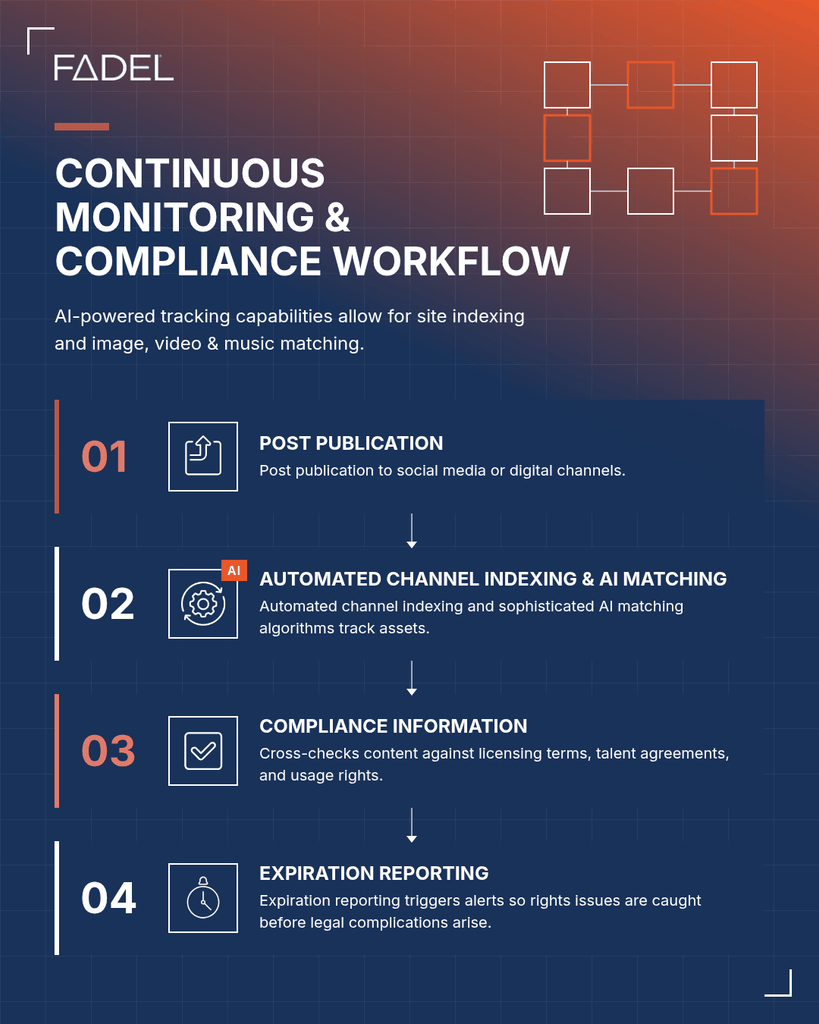
With content deconstructed and classified, continuous monitoring moves from concept to workflow:
- Post-publication tracking across digital and social channels.
- Automated channel indexing and AI matching for images, video, and audio clips.
- Rights verification checking live usage directly against contract terms, talent agreements, and usage rights.
- Expiration reporting to catch rights issues before they become legal ones.
Continuous monitoring also helps brands identify unauthorized resellers, track grey market activity, and detect misuse of official product imagery across online marketplaces and social channels. In contrast, manual searches are like looking for a needle in a haystack: resource-heavy, technologically limited, and constantly blocked by guarded social media environments. According to a FADEL customer survey, performing content searches with image and video recognition is up to 98% faster, creating a cost-effective path to managing copyright risk at scale.
The brands that stay protected in this new AI environment are the ones that treat brand protection as continuous infrastructure, not a quarterly review.
Key Takeaways
- Centralize content and rights data: You can’t govern what is scattered across siloed drives.
- Use AI for continuous monitoring: Shift from periodic audits to automated, real-time oversight.
- Employ AI analytics: Base your enforcement strategy on clear risk tiers and high-impact targets.
- Build compliance into the workflow: Embed rights checks, content tracking, and expiration alerts right where assets live.
Your digital rights management strategy isn’t just about administrative compliance anymore. In an AI-driven marketplace, it is your first line of defense .
Want to talk about what AI-driven brand protection looks like for your organization? Reach out to solutions@fadel.com to set up a personalized strategy session with one of our AI and compliance specialists.