How outdated email and spreadsheet workflows slow down getting products to market
In the licensing industry, speed to market can make or break product performance. Especially for trending properties like new-release movies or winning sports teams, timing is critical, and delays can mean missed opportunities. Licensors need to work closely with licensees so they can quickly launch new product lines while still protecting brand consistency across every SKU.
Yet, despite the rising complexity and pace of the licensing business, many licensors still rely on outdated, manual product approval workflows. Email chains, disconnected spreadsheets, and inconsistent review processes are still the norm in many cases. These outdated and inefficient tools cause delays, produce errors, and introduce risk.
That’s why leading licensing organizations are implementing processes to automate product approval workflows. In this article, we examine the hidden costs of legacy processes and how product approval software can help licensees and licensors reach profitability faster.
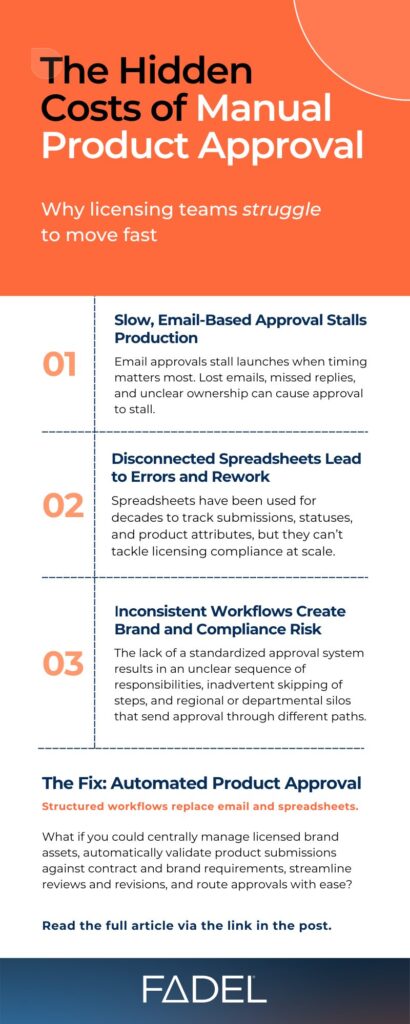
Hidden Cost #1: Slow, Email-Based Approval Stalls Production
Email is often the default method for routing product submissions, but it wasn’t designed to manage structured, multi-step approval workflows. When teams rely on email threads to review product designs, packaging, or marketing assets, several problems arise:
- Approval gets buried in long, fragmented email chains.
- Key reviewers are accidentally omitted, or messages get forwarded inconsistently.
- Contributors struggle to identify the correct or most recent version of a submission.
- Feedback is scattered across multiple messages, making it hard to track required revisions and final agreements.
Email inefficiencies have a ripple effect on the product development cycle. Lost emails, missed replies, and unclear ownership can cause approval to stall, with hours wasted sending manual follow-ups, digging through inboxes to find feedback, or re-sharing files that reviewers can’t locate. And when product approval cycles slow down:
- production and manufacturing are delayed for licensees,
- product launches and promotions slip,
- partners grow frustrated by the lack of visibility and lengthy timelines,
- and internal teams lose valuable time that could be spent on sales and innovation.
Hidden Cost #2: Disconnected Spreadsheets Lead to Errors and Rework
Spreadsheets have been used for decades to track submissions, statuses, and product attributes, but they can’t tackle licensing compliance at scale. As products and partners multiply, spreadsheets introduce serious challenges.
- Multiple versions of the same file circulate across teams.
- Manual data entry increases the likelihood of mistakes.
- Spreadsheets quickly become outdated as review volume grows.
- Information gets scattered, making it difficult to maintain accuracy.
- Data visibility is low and searches are limited to simple filtration.
- Advanced analytics aren’t possible.
This lack of structure is especially problematic for global licensing teams that manage hundreds or thousands of SKUs each year. Errors can cause damage to brands when incorrect rights or product details get approved. This can lead to significant and often costly rework downstream, including product redesigns, additional manufacturing runs, and correcting compliance violations.
Hidden Cost #3: Inconsistent Workflows Create Brand and Compliance Risk
The lack of a standardized approval system results in an unclear sequence of responsibilities, inadvertent skipping of steps, and regional or departmental silos that send approval through different paths. These inconsistencies increase the likelihood that mistakes or non-compliant designs slip through unnoticed, weakening brand protection and quality control.
- Data inconsistencies may lead to product variations that are misaligned with contractual licensing requirements.
- Off-brand or inaccurate designs may be submitted or approved.
- There is no reliable audit trail documenting who approved an item and when.
For global brands, these risks are amplified and can cause lasting damage, from consumer dissatisfaction to rights infringements.
Why Licensors (and Licensees) Need Automated Product Approval Software
- Scalability and Efficiency As the pace of consumer product innovation accelerates and partner networks expand, spreadsheet management, repetitive tasks, and error-prone manual approval systems impede growth.
- Better Planning Predictable review steps help licensees plan better for manufacturing, retail launches, and marketing campaigns, freeing up time to focus on sales strategy.
- Faster Time-to-Market Automated workflows shorten approval cycles and reduce delays, enabling licensees to release products to market and generate royalties faster.
- Improved Partner and Team Experience Licensing partners get full visibility into status updates and expected turnaround times, while internal teams benefit from a smoother, more efficient collaboration model.
- Stronger Brand Consistency Built-in compliance checks ensure every product adheres to quality guidelines and brand standards.
- Risk Reduction With centralized, accurate data and standardized workflows, licensors avoid rights violations and inadvertent errors.
- Informed Decision Making Analytics and reporting surface trends and performance insights to guide smarter, faster decisions.
Introducing FADEL’s Automated Licensing Product Approval Solution
FADEL’s product approval software is designed specifically for the complexities of licensing. It replaces manual tools with a structured, automated system that brings order and efficiency to every step of the product approval process.
A Centralized, Structured Approval Environment Product submissions, assets, versions, comments, and approval are all stored in a single, secure location that is accessible to stakeholders. This eliminates the chaos created by email- and spreadsheet-driven bottlenecks while making it easy for teams and partners to collaborate.
Automated, Configurable, Role-Based Workflows Intelligent routing sends each submission to the correct reviewers based on IP, product category, and submission type. Additionally, different workflow stages can be configured for different products. System-driven notifications and reminders ensure tasks don’t get stuck or forgotten.
Intelligent AI Agent The AI agent performs an initial review of a licensee’s product submissions, validating them against licensing agreements and uploaded assets. Any conflicts are automatically sent back to the licensee for correction before the submission advances to the licensor for human review, saving valuable time.
Real-Time Visibility and Tracking Dashboards provide instant visibility into every item in the approval pipeline:
- What’s pending
- What’s in review
- What’s late
- Who the current owner is
- Where the bottlenecks are
This transparency accelerates approval and strengthens communication across partners and internal teams.
Compliance and Accountability FADEL enhances governance and brand integrity with time-stamped approval logs, standardized workflows, and clear audit trails. Built-in version control and full version histories prevent conflicts, outdated attachments, and duplicated files. Licensors can be confident every product that reaches the market has been reviewed consistently and thoroughly.
FADEL’s product approval software automates repetitive tasks, reduces administrative burden, and supports business growth. By moving away from emails and spreadsheets and adopting a streamlined, intelligent system, licensing teams can significantly improve speed-to-market and operational efficiency.
Schedule a demo today to explore the features of FADEL’s product approval software and experience how automated approval can transform your licensing workflow.