

Update: : On March 2, 2026, the U.S. Supreme Court declined to hear Thaler v. Perlmutter, effectively upholding lower court rulings that AI-generated works without human authorship cannot be copyrighted. By refusing to review the case, the Court maintained the US Copyright Office requirement that only works created by a human being are eligible for copyright protection.
Ownership, copyright, and licensing questions are turning AI-generated content into a legal grey area for brands.
In just a few years, content creation has shifted from a purely human endeavor, drawing from the skills of artists, designers, writers, and videographers, to one where artificial intelligence can generate eye-catching images, interactive videos, and long-form copy in seconds. For brands and media companies, this means faster production, lower costs, and the ability to create content at scale.
The problem is, this leap into AI-generated content precedes the development of legal frameworks that govern it. As companies bring AI into marketing, design, and production, they run into a fundamental question that doesn’t yet have a clear answer: who owns what AI produces?
If a business assumes AI-generated content is automatically free to use or fully owned, it could face legal trouble. From copyright infringement lawsuits to the inability to protect brand assets, the consequences can impact a brand’s finances and reputation.
This article breaks down how ownership of AI-generated content works today, where the legal risks lie, and how brands can apply rights management strategies to manage risk.
Why AI-Generated Content Ownership Raises Legal Questions
Copyright law is built on the idea that a human creates something original, and the law protects it. In the U.S., Europe, and most other regions, authorship has always assumed that the creator is a human being exercising intent, emotional expression, and intellectual choices.
AI copyright law is now forcing a re-examination of these laws. When software produces an image or a song based on patterns learned from huge datasets, it’s not clear whether that output qualifies as a work of authorship. Courts and regulators are still figuring this out, and several questions remain unresolved.
1. Can an AI be recognized as an author?
Right now, in most jurisdictions, the answer is no. Most legal systems require a human creator for a copyright to exist, so while an AI-generated image might look no different from a human-made one, legally it may have no author and no copyright protection.
2. Does the user of the AI platform own the output?
Most users assume that if they pay for a subscription to a generative AI tool, they own whatever it produces. In reality, ownership often comes from the platform’s Terms of Service, not from copyright law. While platform Terms of Service often grant ownership rights to the user, this is a contract between the user and the company. It doesn’t guarantee that a court or copyright office will recognize the work as protected IP belonging to the platform user.
3. Does the AI company hold ownership?
Some platforms reserve rights to reuse or license generated content, particularly for free-tier plans. This can lead to scenarios where a brand uses an image for a global campaign, only to find they have unknowingly granted the AI platform a license to use that same image elsewhere.
4. How are Training Data and Derivative Works Handled?
One of the most contested issues is how AI models are trained. Generative AI models ingest billions of data points, like images, text, code, and music, often without the consent of the original rights holders. If an output closely resembles a copyrighted work, for example, AI generates a logo that bears a striking resemblance to something it saw during training, who is liable? Courts are actively dealing with these issues, and questions regarding derivative works and plagiarism are currently being litigated.
Types of AI-Generated Content and Their Risks
Ownership and licensing issues vary depending on the type of content being generated by AI. Different media formats introduce different challenges to marketing departments regarding rights, usage, and potential infringement.
Images and Graphics
AI image tools can now produce stock-style photos, illustrations, and even logo concepts that are used as marketing visuals, in social media posts, as storyboards, and for website design. The legal risk in this area is style imitation. If a brand generates an image using a prompt that references a living artist or recognizable visual style, it can trigger claims related to misappropriation or unfair use, even if the output isn’t a direct copy.
Video
AI-generated video includes synthetic presenters, product demos, and realistic simulations that are being used for explainer videos, personalized advertising, and entertainment. This can raise questions around rights of publicity and consent. If an AI-generated person resembles a real individual, legal exposure increases. If that virtual spokesperson resembles a celebrity, the stakes are even higher. Furthermore, video models are trained on existing video libraries, raising questions about whether the output infringes on the rights of copyrighted footage.
Music and Audio
AI can compose music, generate sound effects, and clone voices for commercial soundtracks, podcasts, and voiceovers. The music industry is notoriously litigious, and music rights are complex because composition, performance, and voice rights all come into play. Voice cloning, in particular, raises serious consent and publicity issues.
Text and Copywriting
AI writing tools are now standard in marketing departments for drafting blogs, ad copy, product descriptions, and personalized email campaigns. While text can be harder to police for copyright than images, music, or videos, issues of plagiarism still remain. If an LLM (Large Language Model) regurgitates substantial portions of a protected text, the user could unknowingly publish infringing content.
Cross-Media and Component Content
Many campaigns now combine AI-generated content in different media forms, for example text, video, and audio, for more immersive experiences and dynamic advertising. Different AI tools may be used to generate the different modes of content, creating layered licensing issues. This means you aren’t just clearing one asset, you are managing a complicated chain of rights where the legal status of each component might differ.
Can AI-Generated Content Be Copyrighted?
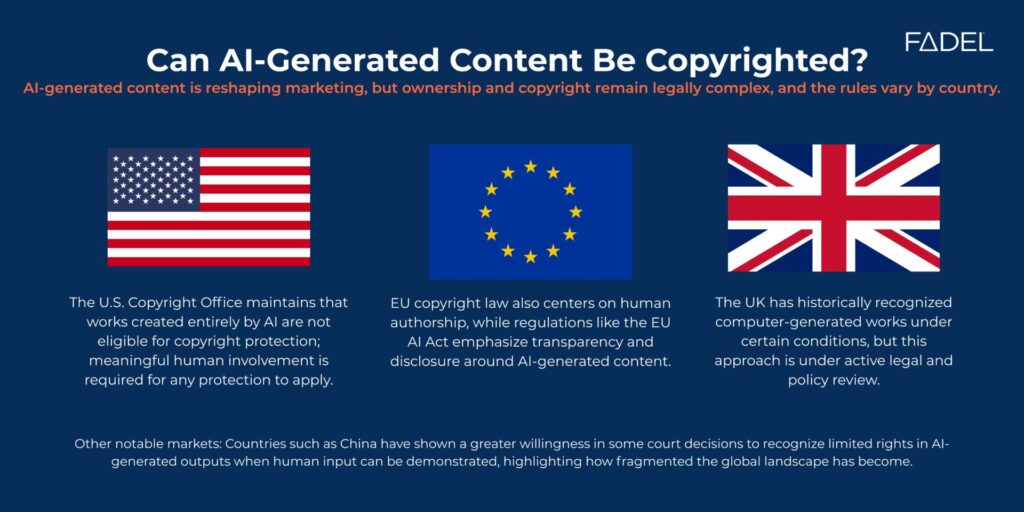
The billion-dollar question is whether AI-generated content can be copyrighted. If you invest time and money into AI-generated assets, can you stop others from copying them? Currently, the answer depends on where you are and how much human input was involved, and is still changing as the legal framework for the rights to AI-generated content continues to be forged.
The United States
The U.S. Copyright Office (USCO) has taken a firm stance on AI-generated works: without human involvement they are not eligible for copyright. The USCO views copyright as a protection for “fruits of intellectual labor” founded in the creative powers of the mind. In the U.S.:
- Human involvement matters. In recent guidance and rulings, the USCO has clarified that if a work is created entirely by a machine, it is in the public domain. However, works that combine AI generation with significant human creativity may qualify for limited protection.
- Prompts aren’t enough. Typing instructions into an AI tool is generally not considered sufficient human control to warrant copyright. However, if a human artist uses a program like Adobe to significantly alter an AI-generated image, or if the AI is used merely as an assistive tool in a larger creative workflow, the human-created portions may be protected.
- Litigation is ongoing. According to a recent analysis by Mayer Brown, the U.S. legal system relies heavily on the fair use defense regarding the training of these models. Courts are currently deciding case-by-case whether training AI on copyrighted works constitutes fair use. While some courts have found the training to be transformative and thus fair use, others have ruled against it, particularly when the output competes commercially with the original works. Outcomes vary and the law is still in flux.
The European Union
The EU focuses heavily on transparency and disclosure through regulations like the EU AI Act. While the Act focuses heavily on safety and transparency, requiring disclosure when content is AI-generated, copyright laws in EU Member States, similar to the U.S., are tied primarily to human authorship. However, emerging requirements around training data and disclosure could affect future ownership and compensation claims.
The United Kingdom
The UK has historically been more open to computer-generated works. The Copyright, Designs and Patents Act of 1988 theoretically allows for copyright in computer-generated works where the author is taken to be the person who undertook the arrangements necessary for the creation of the work. However, recent debates and court cases have brought this approach under review. As noted by Mayer Brown, the UK government is consulting on text and data mining (TDM) exemptions. While the UK allows TDM for non-commercial research, there is ongoing debate about extending this to commercial AI training, provided rights holders have an opt-out mechanism.
In the famous Thaler case, courts in both the US and UK ruled that an AI cannot be named as an inventor on a patent. This reinforces that whether it’s an invention or a creative work, the law currently demands a human at the center.
The bottom line is, global brands can’t assume one rule applies everywhere. An AI-generated asset might have limited protection in one country and none in another. For example, a logo generated by AI might be potentially protectable in one market but considered public domain in another, meaning competitors could legally copy your AI-generated brand assets without penalty.
5 Ways to Manage Risk for AI-Generated Content
Since copyright protection for AI-generated content cannot be guaranteed, brands can mitigate risk by turning their attention to contractual rights and compliance.
- Review Platform Terms of Service Carefully. Never assume the default settings apply to you. Dig deeper to examine whether the tool explicitly allows commercial use of the outputs. Some free versions of AI generators are for personal use only.
- Consider Your Subscription Tier. Enterprise-tier subscriptions sometimes come with indemnification clauses, where the AI vendor agrees to cover legal costs if their output results in a copyright lawsuit. Free or standard tiers rarely offer this safety net.
- Evaluate Human Input. To maximize the chance of securing AI copyright law protection, document the human creative process. Track edits, iterations, and post-production work, and use a human-AI-human workflow where possible. For example, start with human ideation, generate a draft with AI, and finish with meaningful human editing. The more human creativity involved, the stronger your position.
- Use Contracts to Protect Your Brand. First, you want to ensure you have the rights to any reference images or data you upload into an AI tool. Second, require your vendors and agencies to disclose any AI use. And third, clearly assign liability in contracts.
- Track, Document, and Record Everything. In the event of a legal dispute, your paper trail is your defense. Keep a record of the prompts you use to generate assets. This helps prove that the specific expression was directed by a human. And, just like traditional stock photography, AI content should be tagged with usage terms, preferably in a modern digital rights management system rather than just metadata.
How FADEL Helps Navigate AI-Generated Content Usage
As content volumes grow and human vs machine sources continue to converge, manual tracking no longer works. FADEL provides the structure needed to manage AI-generated content alongside traditional assets.
Centralize Rights Data
FADEL’s Brand Vision platform allows organizations to store AI content licensing terms alongside traditional asset rights. Whether an image was shot by a photographer, licensed from a media outlet, or generated by AI, the rights data lives in a single, centralized location. This ensures you know exactly where every asset came from and what rules apply to it.
Automate Compliance
With Brand Vision, you can flag assets with limited or no copyright protection and track expiration dates on subscriptions, territory restrictions, and specific allowable usages for AI outputs.
Enable Collaboration Across Teams
By integrating rights management into the creative workflow, legal teams can set the guardrails (e.g., “Do not use AI for TV commercials”), and creatives see these statuses in real-time. This visibility prevents downstream legal bottlenecks.
Integrate with Existing Workflows
FADEL Brand Vision is open and extensible, connecting directly to Digital Asset Management (DAM) and other systems. When a designer uploads an AI-generated image to their DAM, they can be prompted to input the source tool and human involvement level.
Support Future-Proof Strategies
Ultimately, AI-generated content sits in a legal grey area. The laws surrounding content ownership continue to evolve, and decisions from the U.S. Supreme Court or new UK legislation could flip the current rules overnight. FADEL’s flexible architecture allows brands to update their rights logic globally. If a new law dictates that AI content must be watermarked or reported, FADEL helps implement that policy across your entire content library instantly.
For forward-thinking brands, the strategy cannot be to wait for the courts to decide, yet the risk of assuming AI content is automatically free to use, exclusive, or safe to use are too high to gamble. By treating AI-generated content with the same care as licensed third-party assets, organizations can use AI tools confidently while protecting their brand. FADEL helps make that possible by ensuring every asset, whether human-made or AI-generated, is tracked, cleared, and used appropriately.
Contact our experts for a demo.
